SoundWorld Music Program
The SoundWorld Music Program is designed to develop auditory emotional awareness skills in 2nd-5th graders with a series of workshops and interactive concerts.

Introduction
What even is auditory emotional awareness? Why is it important?
Auditory emotional awareness is our ability to pick up on these emotional signals in sound. It involves sensitivity to pitch, timbre, tempo, prosody (the vocal pattern of speech), and the acoustic cues that carry meaning. This awareness also includes the ability to recognize our own physiological responses, mental imagery, and emotional reactions when we hear certain sounds.
Music is found in virtually every human culture, and many scholars believe it evolved directly from primitive affective vocalizations—those involuntary sounds like laughs, grunts, or sighs that communicate our most basic emotions. Hermann von Helmholtz theorized that early music likely emerged from an “endeavor to imitate the involuntary modulations of the voice.” In other words, music grew out of the way humans sound when they feel.
Developing auditory emotional awareness strengthens our ability to interpret others, regulate our own emotions, and understand how sound shapes human communication and connection.
What’s this got to do with music?
If music likely emerged from vocalizations, then understanding emotional sound means returning to its origins. Speech prosody—the rhythms, tones, and contours that accompany language—has been studied far more extensively than emotion in music, yet both rely on the same acoustic cues. Musicians use these cues instinctively: varying tempo, articulation, intonation, vibrato, and timbre to express emotion just as a speaker does.
Angry music and angry speech both tend to be fast, loud, and high-pitched; sad music and sad speech tend to be slow, soft, and low-pitched.
Research shows that the processes underlying emotion recognition in speech and music develop in parallel and rely on overlapping neural networks. Children’s understanding of emotion in music is related to their understanding of speech prosody, and studies show that these skills improve with age and develop alongside each other. In both tonal and atonal language communities, the characteristics of speech prosody mirror the tonal characteristics of each culture's music. This deep connection suggests that examining vocal emotional expression can give us insight into how we perceive emotion in musical sound.
This project builds directly on that relationship by using nonverbal emotional vocalizations and their musical analogues to help participants experience how emotional meaning travels from voice to instrument.
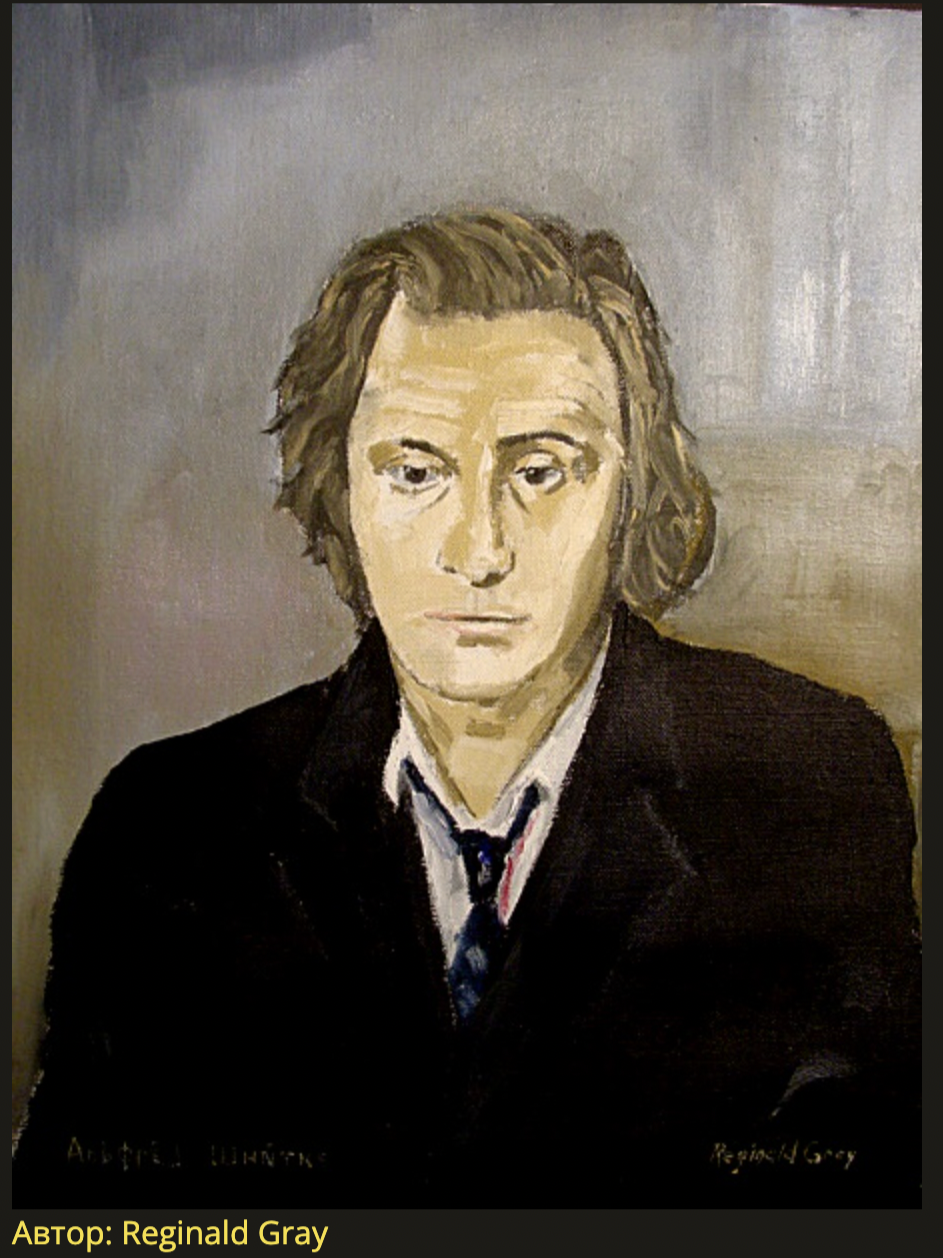
Who is Alfred Schnittke? Why him?
My fascination with Schnittke began at age fifteen, long before I seriously considered music as a career. Most active in the 2nd half of the 20th century, Schnittke developed some of the most innovative instrumental techniques for emotional expression. Though his music was deemed controversial by the Soviet Regime, Schnittke remains, to me, one of the most masterful manipulators of sound and idiomatic imitators of the human voice in instrumental music.
His music also holds personal significance. I grew up in a Russian-Jewish immigrant family here in the United States, spending the school year here and the summers in Moscow. The two worlds seemed to me, then, like two disjointed realities. This experience has instilled in me a permanent search for understanding human beings and navigating multicultural disjointedness: What is belonging and connection? What is understanding and accepting one another? What do culture and religion and language play into all of it?
I found solace in Schnittke’s unorthodox techniques and uncanny polystylism. The emotional “bursts” embedded in his work make him an interesting figure for a project rooted in affective vocalization and their musical counterparts. Studying Schnittke allows participants to hear how the raw material of human emotion and how those primitive affective vocalizations reemerge in the musical repertoire of the 20th-century composer.
What kind of activities do you do in your workshops?
The workshops build directly on the Montreal Affective Voices (MAV)—a set of accurately identifiable nonverbal vocalizations portraying basic emotions—and their instrumental analogues, the Musical Emotional Bursts (MEB). Using these tools, participants explore how emotion is encoded in sound. The workshops offered by SWMP guide participants in developing sensitivity auditory characteristics like pitch, timbre, rhythm, melody, prosody (the vocal pattern of speech) and bring awareness to their reactionary physiological responses, imagery, and emotions.
"The workshops offered by SWMP guide participants in developing sensitivity auditory characteristics like pitch, timbre, rhythm, melody, prosody (the vocal pattern of speech) and bring awareness to their reactionary physiological responses, imagery, and emotions.”
“The program culminates in a performance demonstrating how the musical emotional bursts are used in the musical repertoire of composer Alfred Schnittke.”
“(Music)… an endeavor to imitate the involuntary modulations of the voice, and make its recitation richer and more expressive” (Helmholtz, p. 371).
“Schnittke remains, to me, one of the most masterful manipulators of sound and idiomatic imitators of the human voice in instrumental music”
-Shvartsman